Showing posts with label body fat. Show all posts

Saturday, April 23, 2016

How to Lose Fat When Your Body Fat Percentage Is Over 50 Percent


Weight loss requires willpower and dedication, but if you have a lot of weight to lose, it's especially daunting. When your body fat percentage is over 50 percent, you're likely looking at months or possibly years of work to get the physique you want, depending on how much weight loss you plan to achieve. However, you'll likely see noticeable results within the first two months, which can motivate you to keep going. Talk to your doctor before you start on your weight-loss and fitness journey; she can offer guidance to address any underlying health conditions to keep you safe as you get fit and lose body fat.

Starting Your Fat Loss Journey


Exactly how much fat you need to lose depends on your current weight. If you're currently considerably overweight or obese, you should aim for significant weight loss; if you're not significantly overweight, but have a high body fat percentage, aim for a smaller weight loss to help improve your body composition. Your target body fat percentage varies depending on your age and gender; women should generally aim for 16 to 31 percent, while men should try for 10 to 22 percent.

To lose fat, you need to burn more calories than you take in from food and drinks so that your body will release and burn fat to make up the difference. Aim for a loss of 1 to 2 pounds per week, which you can achieve by cutting 500 to 1,000 calories from your daily diet. Following a healthy diet and exercise program, you should be able to lose about 1 percent of your body fat each month, according to the American Council on Exercise.

Use an online calculator to estimate your daily calorie needs, so you can subtract the 500 to 1,000 calories for weight loss. Keep in mind, though, that an online calculator just provides a calorie burn estimate based on your age, gender and size, and it doesn't take into account your body composition. Because fat burns fewer calories than muscle, and you have a higher-than-average proportion of fat, an online calculator might overestimate your calorie needs. Use the calorie target from an online calculator as a starting point, but expect to adjust your calorie intake slightly as you progress until you find an intake that allows you to lose 1 to 2 pounds weekly.

Lowering Body Fat Percentage With Diet


You'll see the fastest results -- and achieve a healthier body composition -- if you adjust your diet to promote fat loss and retain muscle tissue. Make sure you're eating plenty of protein, which provides the amino acids you need to repair and build new muscle tissue. Plus, including protein in your meals also makes them more filling, so you'll feel satisfied even on a calorie-restricted diet. A mix of lean meats, nuts and seeds, dairy and eggs, lentils and beans, and fatty fish supply beneficial protein to help you shed fat. Round out the rest of your diet with whole grains, healthy fats -- like olive oil, flaxseed and avocado -- and fruits and veggies.

Experiment with different flavors on your fat loss journey, so you can find a selection of healthy recipes you truly enjoy. Hitting your calorie target -- not micromanaging your carb, fat and protein intakes -- is the most important aspect of fat loss, according to a study published in the American Journal of Clinical Nutrition. The study authors looked at the effects of four different types of calorie-restricted diets -- each with different proportions of fat, protein and carbohydrates -- and found they were all equally effective for weight loss. Ultimately, you'll get better results if you find a healthy diet you can stick to, rather than feeling forced into a diet you dislike and eventually give up.

Increase Your Fat Burn With Cardio


Getting more activity is key for fat loss -- heart-pumping aerobics increase your calorie demands for the day, and each workout will help you melt away fat. Find a few aerobics you enjoy -- for example, water aerobics, rowing, elliptical, brisk walking or running -- and cycle through your favorite activities throughout the week to avoid boredom.

If you're working out on a cardio machine, like an elliptical, don't feel obligated to stay in the "fat-burning" heart rate zone, which usually requires that you work at a low intensity. You'll actually burn more calories if you push yourself to work out at a moderate or vigorous intensity, which ultimately burns more fat and calories than staying in the fat-burning zone.

Improve Body Composition With Strength Training


Incorporating strength training into your routine also helps you lose fat. Strength training builds muscle -- a highly metabolically-active type of tissue -- so you're able to burn more calories throughout the day. It also helps you retain muscle as you lose fat, which will help ensure you're at a healthy body fat percentage when you hit your goal weight.

Schedule strength-training workouts into your routine twice or three times weekly, and make each session a full-body workout. Consider hiring a professional to conduct a fitness assessment and design a program for you. At a higher-than-average body fat percentage, some exercises might be especially difficult and require modification, at least until you get stronger and lose some body fat. A personalized program will get you the fastest results with the least risk of injury.

source by : http://www.livestrong.com/article/429085-what-is-the-fastest-way-to-lose-body-fat-when-your-body-is-50-percent-fat/

Friday, April 22, 2016

Lower Your Body Fat Percentage (in 10 Easy Steps)

The 10 easy steps you should follow to lower body fat percentage and reveal your six-pack.

Want to see your abs? As you almost certainly know by now, no amount of situps will help. Your rectus abdominis are already plenty big enough - they're just lurking under a protective cushion of unsightly fat. To see them, you'll need to drop down to the 12% bodyfat level – and to really make them pop, single digits are the key. How do you get there? Easy: by doing the following.

1. Eat more. Yes, you read that right. The key, though, is what to load up on. 'Add two fistfuls of green veg to every meal,' says Precision Nutrition's Brian St-Pierre. They're nutrient-dense but low on calories - so they'll fill you up without being fattening, and keep you healthy.

2. Try to drink a glass of water with every meal. It'll keep your body hydrated and full, and keep your metabolism online. Soft drinks? Out.

3. Enjoy eating out. Don't be the man ordering steamed chicken breast - as long as you're getting a decent hit of protein and green veg in, the steak and spinach is fine. Just leave the frites for cheat day.

4. Get stronger. Not everyone's first priority, but shifting more weight will make any workout more intense. By adding 1.5kg worth of muscle to your body you have the potential to burn 1,050 extra calories a week, according to a study by the University of Michigan. Aim to progress in big, compound lifts like the power clean and squat, and every workout becomes a fat-burner.

5. Go green. For tea, anyway - it's the most natural fat-burner available. Pair it with lemon to blunt your insulin response, making your body less likely to store food as fat.


6. Up the speed Medium-intensity cardio ups your cortisol and turns you into a fat-storage unit: so keep it short and aggressive. Try a Tabata row: 20 seconds' work, 10 seconds' rest, repeated 8 times. The catch? You need to manage 100 metres every interval.

7. Get a taste for spicier food. Capsaicin, the compound that gives chilli peppers their heat, will also play merry havoc your metabolism. Add paprika to your home-made burgers - you, uh, do make them from scratch, right? - and turn them into a fat-burning feast. 

8. Drink milk. There is some evidence that calcium deficiency could slow metabolism. Research has shown that consuming calcium through dairy foods like low fat yoghurt or –fat-free-cheese could also contribute to reducing fat absorption from other food sources.

9. Increase your vitamin D levels. This doesn’t include sitting in the sun for hours on end. Vitamin D absorbed from food is essential for the preservation of muscle tissue. You can get 90% of your recommended daily intake from a 100g piece of salmon. So eat plenty of fish, eggs, milk and cereals to get your intake up. And sit in the sun if you like, it can’t hurt…

10. Get your fibre on. Research has shown that some fibre can fire up your fat burning by as much as 30%. These studies have found that those who are consuming the most amount of fibre are gaining less weight over a period of time. It’s best to aim for around 25g per day.

SOURCE BY : http://www.coachmag.co.uk/exercises/lose-weight/3756/lower-your-body-fat-percentage-10-easy-steps

Monday, April 18, 2016

The Low Down on Body Fat


Most of us would be aware of BMI (Body Mass Index) as a tool used to measure an individuals healthy weight range relative to their height and gender. We’ve been advised to monitor our BMI and are encouraged to keep it in the healthy range and don’t allow it to creep into the over weight or obese categories.

The problem with BMI is that the scientific evidence suggests that it is not an accurate predictor of a health when it comes to ageing.

Most studies indicate that having a higher BMI as we get older is linked to a lower mortality rate. That’s right. Higher BMI, live longer.135,136

What’s going on and is there a better indicator for health?

A recent study from Canada followed more than 50,000 middle-aged and older Canadians and found that body fat percentage is a better predictor of life expectancy than BMI. Being on the thin side or having a low BMI didn’t protect against early death. The results supported previous studies that show that mortality rates increased as BMI decreased and body fat percentage went up.137

The researchers reported that both low levels of lean mass and high levels of body fat are independently associated with increased risk of death, and concluded that a direct measure of body fat is really the most accurate way to determine health in ageing.

Does that mean that all these BMI studies are telling us that being fat is healthy?


The reason for this apparent contradiction is you don’t have to be “fat” to have a high BMI. For example if I put my height and weight figures into a BMI calculator (this one from the Australian Heart Foundation) it tells me I’m 1kg from being “overweight”, yet my body fat percentage is 12% (I range between 9-13% depending on my training goal). The more likely explanation is that many of the high-BMI participants of these studies may have low body fat and high lean mass and subsequently any measure of health should place them in a "healthy" range, not a high risk range for mortality!


So what is body fat and how do we measure it?

If you weigh 100kgs, and 10 kgs of that is fat, then your body fat percentage is 10%. 15kgs of fat would put it at 15%, 20kgs at 20%, you get the idea.

If you gain or lose only fat, your body fat percentage goes up or down accordingly. But it can also go up without gaining fat, and down without losing fat.

How is that possible? IT'S ALL ABOUT YOUR MUSCLE


Let’s say you’re fairly muscular and weigh 90kgs with about 12kgs of that being fat. That puts you around 13% body fat ((12/90) x 100).  And if you were 185cm tall and male then your BMI would be 26 (Overweight range). If you stopped training (that is, lifting heavy weights) and lost 10kgs of muscle over the course of a year, without losing any fat, you now weigh 80kgs with the same 12kgs of fat. Your new body fat percentage is about 15% ((12/80) x 100) and your BMI (assuming you haven’t shrunk) is now 23 (Healthy range).

Of course we would all like to be going the other way, so let’s say you (the same 185cm male) weigh 85kgs and are carrying 10kgs of fat. Your body fat percentage is around 12% and your BMI is 24 (Healthy). If you gain 5kgs and little-to-no-fat, you’re now back to weighing 90kgs with the same 10kgs of fat, so your body fat percentage has now dropped to 11% but your BMI has gone back to 26 (Unhealthy).

It wouldn’t be one of my articles if I didn’t mention Age – Most calculations and images for determining body fat percentage  assume ages of around 25-35 years old. The reality is that there will  be higher body fat levels as your age increases. For example, a 20 year old man and a 50 year old man may have the same subcutaneous body fat measurement (fat under the skin), but the 20 year old may be 15% body fat and the 50 year old will be at 20%. Doesn’t sound fair, does it? As part of the ageing process, not only are we losing muscle (sarcopenia) but the fat around the organs (visceral) and within muscle (intramuscular) tends to increase.

While there is some debate as to what constitutes a “healthy” body fat range, there are some reasonable guidelines available.

Body Fat Percentage Chart

The chart below from the American Council on Exercise (ACE) is one of the most commonly used body fat charts.138 As you can see, women have a higher body fat percentage relative to men for a given level. Women have more fat because of physiological differences such as hormones, breasts, and sexual organs. In addition, women need a higher amount of body fat for ovulation.

Unless you’re a competitive bodybuilder and know exactly what you’re doing, I recommend you never try to reach the Essential Body Fat range. Organ failure can occur in this range, and it can only be maintained for a day or two. If you reach the athletic range, you’ll have a lean, ripped physique that the fitness enthusiasts like to achieve (this is where most six-packs kick in).

The limitation of this chart is that while it takes into account gender differences, it does not take into account your age, which is important for us over 40.

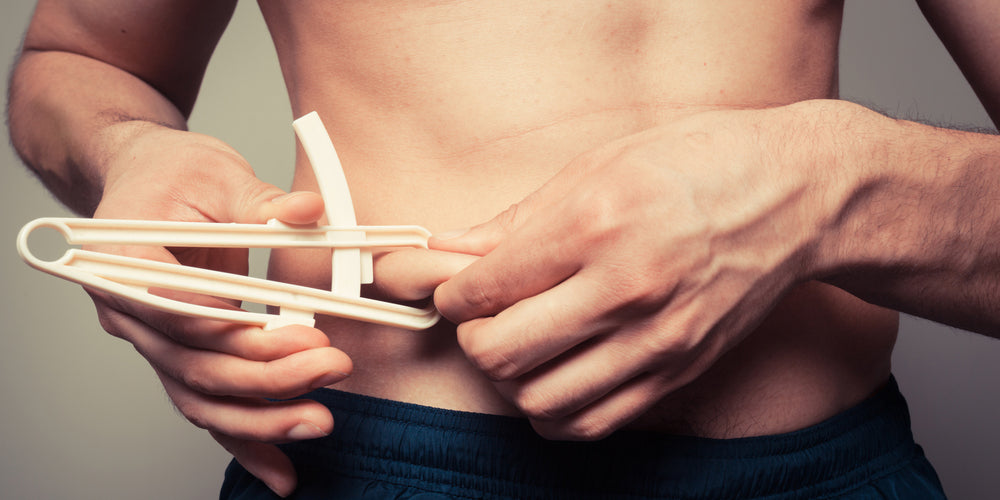
AccuFitness is the maker of the popular Accu-Measure Body Fat Caliper, which is a one-site skin-fold-body fat measurement method. When you buy the product, AccuFitness includes a body fat percentage chart based on research by Jackson & Pollock and because it utilises age based data (and I use the calliper), it’s the chart I prefer to use. (Full Chart here).139,140

So if you are a 45 year old woman, a body fat percentage of around 22.9% is considered ideal. (feeling better?)

What will I look like?

As you know, body fat percentage varies widely depending on how much muscle someone has.

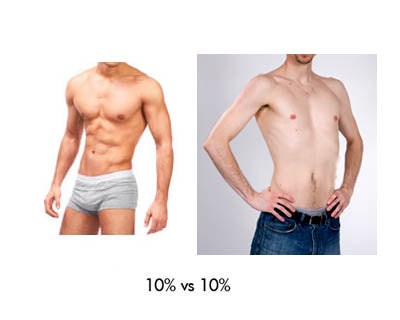
10% body fat on a person with no muscle will look very different than 10% on a person with a lot of muscle, simply because the extra muscle fills out the physique and gives it some definition.

Here’s an example:

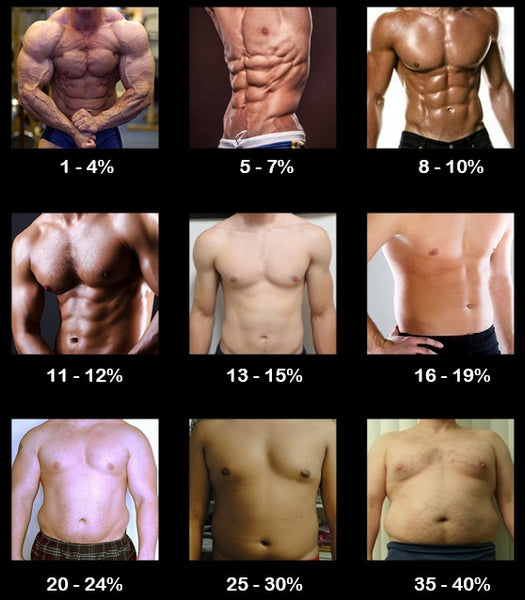
Despite the possible variations, the following images are accurate representations of various body fat percentages given the amount of muscle the men have.

As you’ll see, women look much leaner than men at higher body fat percentages. This is mainly because of the extra fat women naturally hold in their breasts, butt, and hips.

Most of these visuals are pretty accurate for the average woman, with the exception of the leanest categories (most women won’t have this much ab definition unless they’re veteran weightlifters).